

RESEARCH PARTICIPATION

Parkinson’s Queensland is pleased to support current research into Parkinson’s.
Please find below a list of the research projects we are currently aware of.


Parkinson’s Disease Psychosis Research Study

Seeking Participants: Active Now
Specific Area: Gold Coast

Sponsored By:

  • Griffith University
  • International Parkinson’s and Movement Disorder Society

Get Involved & Contact:
Dr. Tien Khoo | Email: t.khoo@griffith.edu.au
Dr. Dharah Puck | Email: dharah.bispo@gmail.com

Title:Development of The Movement Disorder Society Parkinson’s Disease Psychosis Rating Scale (MDS-PDPRS)

Parkinson’s Disease Psychosis Research Study

Parkinson’s Queensland is supporting recruitment for an international research study focused on improving how psychosis symptoms associated with Parkinson’s disease are identified and assessed.

This study is developing and validating the Movement Disorder Society Parkinson’s Disease Psychosis Rating Scale (MDS-PDPRS) — a new tool designed to support better recognition, evaluation and understanding of Parkinson’s-related psychosis.

Who can participate?

  • People diagnosed with Parkinson’s disease
  • Care partners or caregivers of people living with Parkinson’s
  • Living in the Gold Coast area.

How to get involved
If you are interested in participating or would like more information, please contact the research team directly:

CONATCT: Dr Dharah Puck | Email: dharah.bispo@gmail.com

A member of the research team will provide further details about the study and participation process.

By taking part, you are helping advance Parkinson’s research and contributing to improved care and outcomes for the Parkinson’s community.


Parkinson’s Stigma Study

Seeking Participants: Active Now
Timeframe: 14 January – Early May 2026
Ethics Approval: S252164

Get Involved & Contact:
Dr. Sarah Davies | University of the Sunshine Coast
PH: (07) 5409 8693 or Email: sdavies4@usc.edu.au

Title: Using Ecological Momentary Analysis to explore stigma experiences in the real world for adults with Parkinson’s Disease.

Supervisor: Dr Sarah Davies

OT Honours Candidate: Jenna Walker, Christine Fosberry, Santika Miller.

Understanding Stigma in Parkinson’s

Parkinson’s Queensland is currently supporting a University of the Sunshine Coast research study exploring the real-life experiences of stigma faced by people living with Parkinson’s. This study uses smartphone-based surveys to capture everyday experiences as they happen, helping researchers better understand how stigma impacts daily life, wellbeing and social participation.

The findings from this study will be shared internationally at the World Parkinson’s Congress in Phoenix, Arizona (USA), 24–27 May, helping bring Queensland Parkinson’s voices to a global audience.

Eligible participants must:

  • Be aged 18 years or older
  • Have a Parkinson’s diagnosis
  • Live independently in the community
  • Have access to a smartphone with internet/data

Participants will complete short daily surveys over seven days, take part in an initial assessment and join a follow-up focus group discussion. A $20 electronic gift voucher is provided as a thank you for participation.

“We are running a research study to improve our understanding about the real-life stigma that people with Parkinson’s Disease experience. We’ll do this by asking study participants to record their experiences as they happen, using their smartphones.

We are looking for people to join the study who are 18 year or older, with Parkinson’s Disease who live at home (in the community) and have a smartphone with internet/data and know how to use it. The research aims to get a clearer picture of the discrimination people with Parkinson’s Disease face every day.

We want to improve our understanding of how this discrimination happens by focusing on the contextual features, situations, prevalence and types of stigma experienced by people with Parkinson’s as they occur in daily life. This addresses the known gap in research about the daily social and emotional dimensions of Parkinson’s stigma.”
– Dr. Sarah Davies
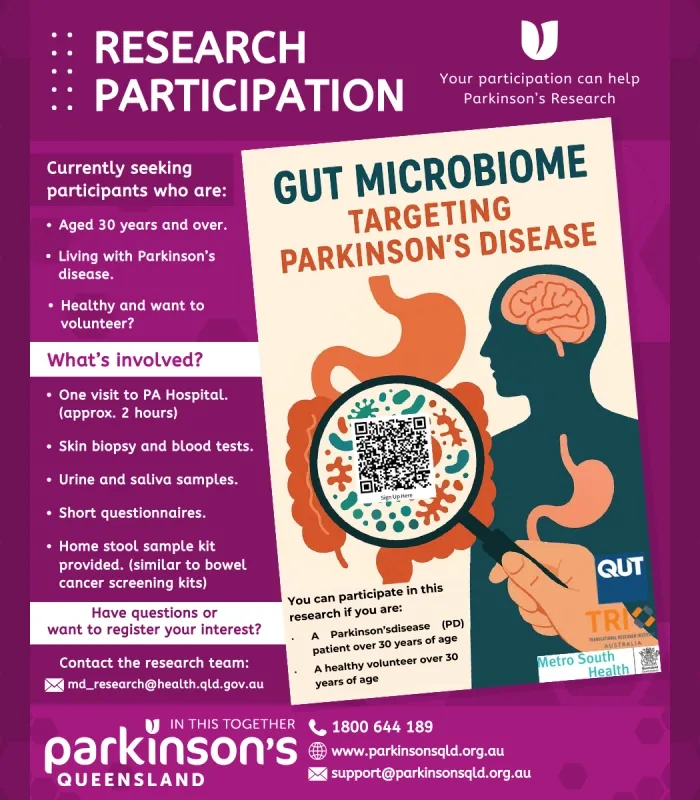


Gut Biome Research

Seeking Participants: Active Now
Timeframe: Ongoing

Help Advance Parkinson’s Research

Parkinson’s Queensland is helping share an important research opportunity at PA Hospital investigating the link between the gut microbiome and Parkinson’s disease.

Currently seeking participants
– Aged 30 years and over?
– Living with Parkinson’s disease?
– Healthy and want to volunteer?

Find out more:
https://www.tri.edu.au/resource/
microbiome-in-health


Contact:
Email: md_research@health.qld.gov.au

Form:
https://docs.google.com/forms/d
/e/1FAIpQLSfozSm1D8s05EdMyC7VCQq-4Q65GgnNMf0QWkLTuDLBI2i6DA/viewform


Investigating the effectiveness of smart shoes in enhancing walking and overall mobility in people with Parkinson’s

One of our PhD Grant Recipients Shanshika Maddumage Dona is conducting a study that investigates the effectiveness of smart shoes and the vibrations they produce in enhancing walking and overall mobility in people with Parkinson’s disease. Your participation, whether as someone directly affected or as a caregiver, is crucial in making a positive impact.

They are looking for people who,

  • Are aged between 40-85 and have received a diagnosis of Idiopathic Parkinson’s Disease (PD) confirmed by a neurologist, or are caregivers of individuals with Parkinson’s disease between the ages of 40-85
  • Are able to walk independently without an assistive device
  • Are able to read, write and understand English
  • Do not have any confounding medical (e.g. severe blood pressure abnormalities), neurological (e.g. stroke), musculoskeletal (e.g. recent musculoskeletal injuries, fractures or surgeries), cardiovascular (e.g. recent cardiac surgeries) or respiratory abnormalities (e.g. Chronic Obstructive Pulmonary Disease, asthma)
  • Do not have any contraindications to wearing smart shoes such as severe peripheral neuropathy or open wound on the feet
  • Have not undergone deep brain stimulation or any other brain injury

If you would like to participate and need more information, please contact Shanshika at shanshika.dona@hdr.qut.edu.au

Please note that this study has been approved by the QUT Human Research Ethics Committee (approval number 7473).

Acute Perturbation training for Parkinson’s Disease

Do you have Parkinson’s disease? Can you walk and stand independently? Would you like to improve your balance and walking?

If yes, The University of the Sunshine Coast are seeking volunteers to trial a simple device that may help your mobility and walking. The purpose of this research project is to evaluate the effects of wearing a novel balance training device, similar to a small backpack, to improve balance, mobility and walking in people with Parkinson’s. If you are over 18 years and have Parkinson’s Disease Hoehn & Yahr Stage 1 to 4, you are invited to participate in this research project. You must be able to stand and walk unassisted by another person to participate (mobility aids/devices are OK)

For more information or to participate in this research study, click ‘Find out more’ below.

Contact: Dr Sue Broadbent
Email: sbroadbe@usc.edu.au Ph: 07 5459 4545

Ethics Approval Number: A231987

The Australian Parkinson’s Pain Study (APPS)

The purpose of the APPS is to investigate the characteristics and treatment of pain in Parkinson’s. This information will be used to develop a set of patient centred recommendations that may be used to advance the provision of pain care services.

Who can participate and what does participation involve?

People of 18 years of age that have been diagnosed with Parkinson’s and have experienced pain symptoms in the past month. Participation involves completing an online survey.

Funding and Ethics

This study is funded through an Australian Government Research Training Program Scholarship and The Hospital Research Foundation Group – Parkinson’s and has been approved by the University of South Australia’s Human Research Ethics Committee (Ethics Protocol 205671).

Click the button below to find out more information or to complete the survey.

Experiences in the Heat with Parkinson’s Disease

Start Date: Now
Investigators: Dr Andrew Hunt, Prof Ian Stewart and Prof Graham Kerr
Ethics Approval: 2000000718

Parkinson’s disease may present with non-movement symptoms including the way the body responds to changes in temperature. However, many aspects of how people with Parkinson’s disease experience the heat, such as their perceptions of heat, its effects on day-to-day activities and quality of life, and whether they experience symptoms of heat-related illness, are not well understood.

There are two aims for this study: 1. To increase knowledge and understanding of how people with Parkinson’s disease experience the heat. 2. To develop a scale for the assessment of heat sensitivity in people with Parkinson’s disease.

You can find out about eligibility and further details by clicking here.

GRIDD Queensland Parkinson’s Project

No person with Parkinson’s disease is the same and finding answers to some of the pertinent questions requires a lot of information and biological samples from many different individuals. The Griffith Institute for Drug Discovery (GRIDD) Queensland Parkinson’s Project (QPP) aims to get information and samples from around 250 new volunteers on a yearly basis.

They are not only looking for people with a neurological disorder, but also welcome those without, who can serve as a control group for comparison analyses. They welcome everyone who wants to participate in this worthwhile research endeavour. It only takes a moment of your time to fill out a questionnaire and the donation of a small blood sample.

Because it is important to know what changes during the course of the disease, they will contact you every year so you can provide them with an update of your situation by completing a short questionnaire.

Driving With Parkinson’s National Survey

A call-out for anyone of any age with Parkinson’s who is still driving or no longer driving.

During national consultations undertaken for the Young Onset Parkinson’s Exchange (YOP-X), driving experiences were highlighted as an area to consider for further investigation. Current information on driving with Parkinson’s in Australia and internationally can assume that Parkinson’s is a condition for older people for whom driving may no longer be a priority. Members of the Young Onset Parkinson’s Working Group have developed a list of topic areas around driving safely and maintaining independence, and additional information collected through this short survey will form the basis of a new driving resource for people with Parkinson’s. Please click on the link below to complete the survey, or direct enquires to Katie at khawtin@hospitalresearch.org.au

UQ: Oral prebiotic to improve symptoms of constipation in Parkinson’s Disease

We are looking for people with Parkinson’s Disease who suffer from constipation. The study involves trialling an oral prebiotic which improves the health of the gut microbiome.

Your participation may lead to the improvement of care for people with Parkinson’s disease.

Keeping time with Parkinson’s Research – The TemPo Studies

If you or a loved one have been diagnosed with Parkinson’s Disease, you or your loved one may be interested in participating in one of the TemPo Studies. They are a suite of three clinical research studies evaluating an oral investigational drug (tavapadon) to see if it may help improve Parkinson’s Disease symptoms that impact movement and daily activities.

Uncovering a Novel Therapeutic Target to Reduce Dementia Risk in Parkinson’s disease

Start Date: Now
Investigators: Dr Nadeeka Dissanayaka, and Dana Pourzinal
Ethics Approval: The University of Queensland Centre for Clinical Research

Dementia is common at advanced stages of Parkinson’s disease. With it comes lower quality of life, increased financial burden, and early institutionalisation. Yet unfortunately, there are currently no known effective treatments to reduce the risk of dementia in Parkinson’s disease. This study is investigating the use of a drug traditionally used for epilepsy to treat early-stage memory problems in Parkinson’s disease. The end goal is to reduce the risk of dementia in people living with Parkinson’s disease, who have a significantly greater chance of developing dementia than the average older adult.

You can find out about eligibility and further details by clicking here.

QUT Light4PD – Photoreceptor-directed light therapy in Parkinson’s disease

Start Date: Now
Investigators: A/Prof Beatrix Feigl, Pro Andrew J Zele, Prof Graham Kerr, Drew Carter, Manuela Russo, Subodh Gnyawali, Prof Simon Lewis, Dr Daniel Schweitzer, and Dr Lucy Burr
Ethics Approval: 2000000435

This research from QUT is seeking to determine the effect of a daily, short duration (30 min) artificial light exposure on sleep and movement in people with Parkinson’s disease. Your participation will involve three laboratory visits to QUT Kelvin Grove and four short home visits from one of the research team members during a period of 6 weeks.

You can find out about eligibility and further details by clicking here.

Speak Out Speech Therapy for Parkinson’s Disease.
SPEAK OUT is a therapy program designed for people with Parkinson’s Disease. You will work together with a speech pathologist for 12 weeks completing speech, voice and cognitive exercises. This program emphasizes speaking with intent and changes speech from an automatic function to an intentional act.

FIND OUT MORE

DOWNLOAD FLYER

Are you having trouble with your balance and gait?

QUT: Effects of Transcranial Direct Current Stimulation on gait in people with Parkinson’s disease

Transcranial Direct Current Stimulation (tDCS) is widely used in neuroscientific and clinical research and is known to improve movement abilities in people with and without Parkinson’s disease (PD). The aim of this research project is to examine whether gait and balance can be improved in people with and without PD using transcranial Direct Current Stimulation.

Are you experiencing postural instability?

QUT: Improving postural stability and reducing falls risk in people with Parkinson’s disease using textured insoles.

You are invited to participate in a study that will improve our understanding of how to prevent falls in older people and people with Parkinson’s disease.

Do you have Parkinson’s? Feeling anxious?

A Non-Drug Treatment Trial for Anxiety in Parkinson’s disease – Participants required

We invite persons with Parkinson’s disease and their partner/caregiver to consider participating in our Parkinson’s disease research study examining a non-drug treatment to reduce anxiety. If you don’t have a caregiver/partner or if your caregiver/partner declines to participate, you can still participate in this clinical trial.

Would you like to dance for exercise?

QUT: Would you like to take part in a study to measure the impact of dance on people with Parkinson’s disease?

We are looking for:
Independently living, ambulatory men or women who are diagnosed as having idiopathic Parkinson’s disease; aged between 30 to 85 years; and who have not participated in a dance programme in the past six months.

Do you have Parkinson’s?

University of Sydney: Discipline of Speech Pathology: Online Survey
You are invited to participate in a study that will evaluate the validity of a Parkinson’s disease specific questionnaire that is currently used by speech pathologists. In this study, you are invited to complete an online survey. All identifying personal information will not be collected and responses will remain anonymous. The questions in the survey will include a range of relevant topics such as personal characteristics, physical and emotional well-being.

Do you have trouble sleeping?

Young Onset Parkinson’s exchange: Survey on difficulties in sleeping and fatigue

We are looking for people with a young onset of Parkinson’s Disease who suffer from sleep difficulties. We are aiming to deepen our understanding of the issue and consequently create ways to improve sleep quality. The study consists of a quick survey that is anonymous.

You can access the survey here:

Lorem ipsum dolor sit amet, consectetur adipiscing elit, sed do eiusmod tempor incididunt ut labore et dolore magna aliqua. Ut enim ad minim veniam, quis nostrud exercitation ullamco laboris nisi ut aliquip ex ea commodo consequat.
Contact Us
  • 1800 644 189
  • pqi@parkinsonsqld.org.au

  • PO Box 4718, Eight Mile Plains QLD 4113


  • PQI operates a flexible hybrid work environment. Should you wish to meet with a staff member in person, please schedule an appointment.
Office Hours

Tuesday to Thursday: 9:00 AM – 4:00 PM